

Inside the Ring Series 6: How We Find the Needles in Cyclic Peptide Haystacks
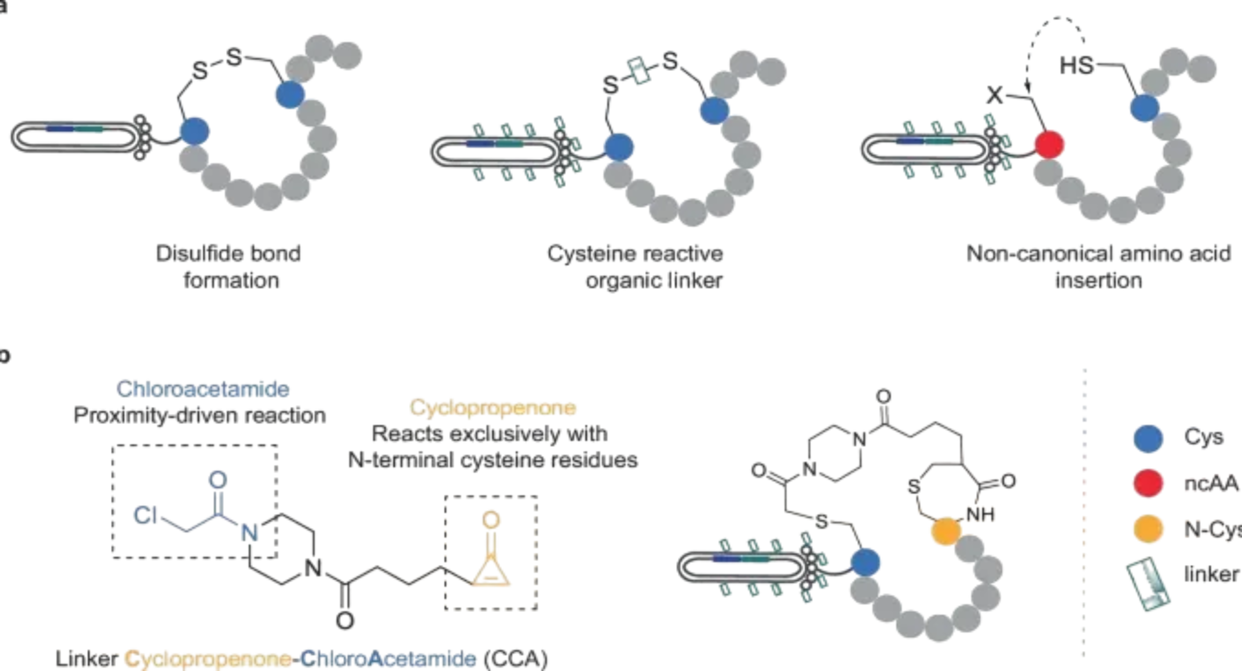
Here's the problem: the therapeutic peptide space is astronomically large. Even a modest 10-amino acid cyclic peptide has 20¹⁰ possible sequences. That's 10 trillion combinations. And that's not counting non-natural amino acids, alternative cyclization chemistries, or bicyclic architectures. Synthesizing and testing each one individually would require several lifetimes and a budget that would make a pharmaceutical CEO weep.
The hunt for therapeutically viable cyclic peptides has brought about a toolkit of screening methodologies, each with its own strategic advantages and inherent constraints. The dominant approaches, Phage Display, mRNA Display, DNA-Encoded Libraries (DELs), SICLOPPS, and Structure-Guided Design, differ fundamentally in how they generate, interrogate, and decode molecular diversity. Thus, understanding these platforms is essential to navigating the modern cyclic peptide discovery landscape.[1-2]
1. Phage Display: The Workhorse
Ever since its discovery by G. Smith in 1985 as a method for presenting polypeptides on the surface of lysogenic filamentous bacteriophages, phage display has been one of the most effective ways to produce large amounts of peptides, proteins, and antibodies.[3]
How it works
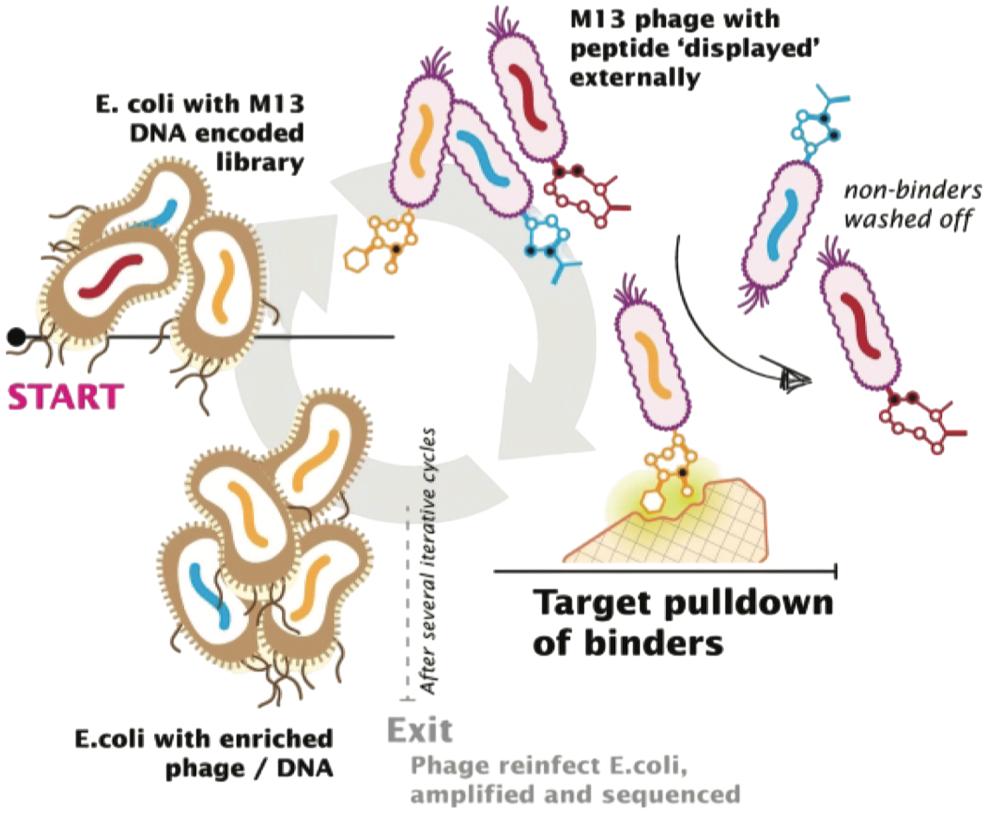
First, a massive library of phages is constructed, each displaying a different peptide nametag fused to a coat protein on its surface. This library is then exposed to an immobilized target protein. Phages bearing peptides that bind the target adhere, while those with weak or no affinity are washed away. The survivors are eluted, amplified by infecting fresh bacteria, and subjected to additional rounds of selection. With each cycle, the population becomes increasingly enriched for high-affinity binders, a molecular evolution compressed into days.
Cyclization on the phage surface
While phage display was originally developed for linear peptides, the real power emerges when those peptides are constrained into loops. Cyclization is most commonly achieved by flanking the randomized peptide sequence with two cysteine residues — either at the termini or bracketing the variable region. Once expressed on the phage surface, these cysteines spontaneously form a disulfide bond (–S–S–) in the oxidative extracellular environment, locking the peptide into a rigid, cyclic conformation. Alternative cyclization chemistries like chemical crosslinkers that bridge non-cysteine residues are occasionally used for more exotic architectures or to incorporate non-natural amino acids, though these remain less common due to added synthetic complexity.
Among companies focusing on cyclic peptides, Bicycle Therapeutics has introduced a distinctive innovation to the conventional phage display platform through its proprietary “Bicycle” molecules. Protagonist Therapeutics, a clinical-stage biopharmaceutical company, uses phage display technology to discover and advance novel peptide-based therapeutics. PharmAbcine Inc., though primarily centered on antibody therapeutics, supports its R&D by using a non-immune single-chain variable fragment (scFv) library.
The Good
- High-throughput capacity: Libraries spanning up to ~10⁸ unique members allow efficient interrogation of sequence space.
- Operational maturity: Decades of refinement have made phage display a turnkey technology. Bacterial infection, phage propagation, and target-based enrichment are now standardized procedures.
- Versatile target compatibility: The platform accommodates a broad range of molecular targets — proteins, peptides, and even nucleic acids.
The Bad
- Library size ceiling: While sizable, phage libraries pale in comparison to cell-free platforms like mRNA display. Diversity is further constrained by reliance on the 20 canonical amino acids.
- Time-intensive workflows: Multiple rounds of selection, amplification, and sequencing extend timelines, making rapid hit identification challenging.
- Membrane impermeability: Because peptides are expressed in bacterial systems, identifying candidates with cell-penetrating properties remains elusive.
2. mRNA Display: Breaking the Billion Barrier
mRNA display takes peptide library construction into the realm of the enormously large. By performing selection entirely in vitro, the platform sidesteps the biological bottlenecks of cellular transformation. [4]
How it works
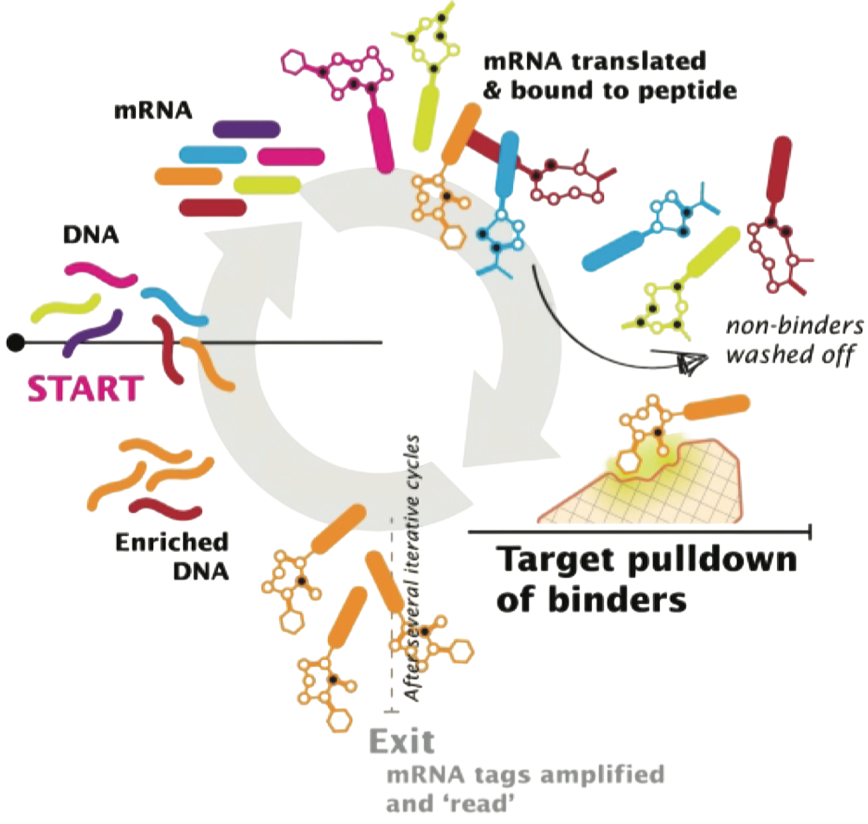
The process begins with the construction of a vast mRNA library, with each member encoding a different peptide sequence. These mRNAs are then subjected to cell-free translation, a reconstituted system containing ribosomes, amino acids, and all the molecular machinery needed for protein synthesis, but no living cells. Here's where clever chemistry comes in: a small molecule called puromycin is covalently attached to the 3' end of each mRNA. Puromycin mimics the structure of aminoacyl-tRNA to sneak into the ribosome's active site during translation. When the ribosome reaches the end of the coding sequence, puromycin gets incorporated as if it were the final amino acid, forming a stable covalent bond between the nascent peptide and its parent mRNA.

The result is a library of peptide–mRNA fusion molecules with each peptide literally wearing its own genetic ID tag. This fused library is then exposed to target protein. Peptides that bind with high affinity are retained while weak binders are washed away. Because each peptide is covalently attached to its mRNA, recovering the genetic information is trivial: the mRNA from enriched clones is reverse-transcribed, amplified by PCR, and sequenced.
Cyclization in the cell-free arena
The cell-free nature of mRNA display opens doors in phage-based systems. Cyclization strategies are far more flexible here, limited only by chemical imagination rather than biological compatibility.
- Disulfide bonds (the classic): Just as in phage display, embedding cysteine residues at strategic positions allows spontaneous disulfide bond formation.
- Chemical crosslinking (the exotic): Because translation occurs in a test tube rather than inside a cell, synthetic crosslinkers can be introduced to covalently bridge peptide termini or side chains.
- Backbone cyclization (head-to-tail): In some implementations, the N- and C-termini are directly ligated using enzymatic or chemical methods, forming a fully backbone-cyclized peptide.
- Non-natural amino acids: Perhaps most powerfully, genetic code reprogramming allows incorporation of non-canonical amino acids bearing bioorthogonal handles that can be selectively reacted to form cyclic constraints unavailable to nature's standard toolkit.
The Good
- Unprecedented diversity: Libraries reaching 10¹²–10¹⁵ members dramatically increase the odds of discovering selective binders.
- Cell-free flexibility: In vitro transcription and translation eliminate the constraints of living systems, enabling rapid prototyping and unconventional peptide architectures.
- Chemical alphabet expansion: Genetic code reprogramming allows incorporation of non-natural amino acids, broadening the accessible chemical landscape.
The Bad
- Technical sophistication: The methodology demands carefully optimized in vitro systems — transcription, translation, mRNA-peptide fusion formation, and selection — each requiring meticulous control. A single misstep in any of these steps can collapse library quality or selection fidelity.
- Cost considerations: Larger libraries and more complex workflows translate into higher reagent and instrumentation expenses. Cell-free translation systems aren't cheap, and scaling to trillions of library members requires significant investment.
- Intracellular access still limited: Despite the ability of incorporating synthetic residues, reliably identifying peptides capable of crossing membranes and engaging intracellular targets remains technically challenging. The peptides that emerge from mRNA display screens are selected for binding, not necessarily for the physicochemical properties.
Two notable companies leveraging mRNA display technology are Ra Pharmaceuticals (now a part of UCB) and PeptiDream Inc.
3. DNA-Encoded Libraries (DELs): Chemistry Meets Genomics
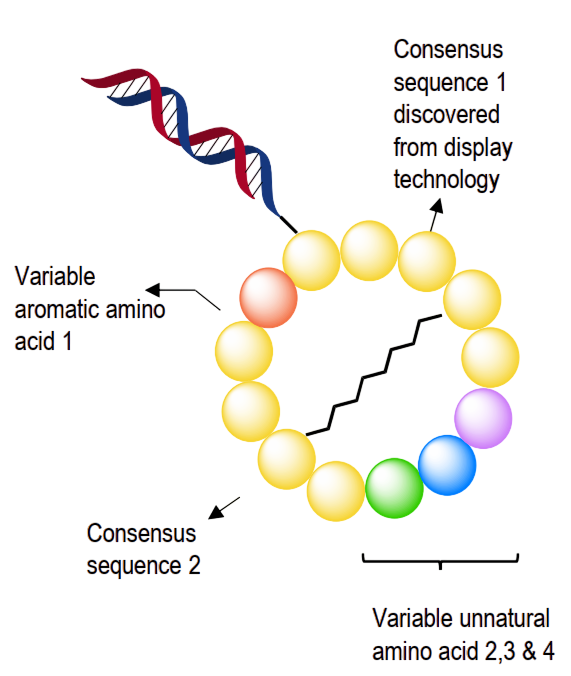
DELs represent a conceptual shift: rather than relying solely on biological expression, they marry synthetic chemistry with DNA barcoding. Each compound in the library carries a unique DNA tag that encodes its chemical identity. [5]
How it works
DEL construction is an exercise in combinatorial chemistry married to molecular record-keeping. The process unfolds in iterative cycles:
- A scaffold molecule is attached to a DNA tag.
- A chemical building block (amino acid, a linker, or synthetic fragment) is added.
- A corresponding piece of DNA encoding the identity of that building block is enzymatically ligated onto the existing tag.
- Repeat.
With each synthetic step, the growing molecule carries an updated DNA barcode that functions as a chemical genealogy. By the end of the synthesis, every molecule in the library has a unique DNA tag that reads like an instruction manual: "I was made with Block A, then Block B, then Block C…" The resulting library is then exposed to an immobilized target protein. The DNA tags of the captured molecules are then PCR-amplified and sequenced en masse. No need to individually synthesize, purify, or test each candidate because the barcode tells you everything.
Cyclization in the Chemical Playground
Unlike phage or mRNA display, which are tethered to the constraints of biological machinery, DELs operate in a chemistry-first environment. This paves the way for cyclization strategies that would be otherwise impossible or impractical in living systems.
- Disulfide bonds (Cys–Cys): The simplest approach, borrowed from biological systems.
- Amide bond cyclization: The N-terminus can be ligated to a side chain carboxylate (e.g., from aspartate or glutamate) or directly to the C-terminus.
- Click chemistry and stapling reactions: Modern bioorthogonal chemistries, such as copper-catalyzed azide–alkyne cycloaddition (CuAAC) or ring-closing metathesis, enable highly selective cyclization using non-natural handles. Peptides can be decorated with azides, alkynes, or olefins at specific positions, then "clicked" or "stapled" into rigid cyclic conformations. These reactions are fast, high-yielding, and compatible with aqueous conditions, making them ideal for DEL workflows. [6]
- Exotic linkers and non-natural building blocks: Because DEL synthesis occurs entirely in the test tube, chemists can incorporate non-canonical amino acids, unnatural side chains, or entirely synthetic scaffolds — expanding structural diversity far beyond what nature offers.
The Good
- Chemical diversity unleashed: DEL construction accommodates natural amino acids, non-canonical residues, poly-amino acid building blocks, and even fully synthetic fragments.
- Rapid hit deconvolution: DNA tags allow PCR amplification and high-throughput sequencing to identify binders without laboriously synthesizing and testing each candidate individually. A single sequencing run can interrogate millions of interactions in parallel, a screening throughput that would be prohibitively expensive or time-consuming with traditional methods.
The Bad
- Binding ≠ activity: DELs excel at identifying molecules that bind to a target, but offer no direct readout of functional activity in cellular or physiological contexts. A hit from a DEL screen tells you that your peptide can engage the target in a test tube.
- Chemical incompatibility risks: Some cyclic peptide chemistries — particularly those involving harsh conditions, strong oxidants, or reactive intermediates — can degrade DNA tags, compromising library integrity and decoding fidelity. Every synthetic step must be carefully validated to ensure the DNA barcode survives intact.
4. SICLOPPS: The Intracellular Gamechanger
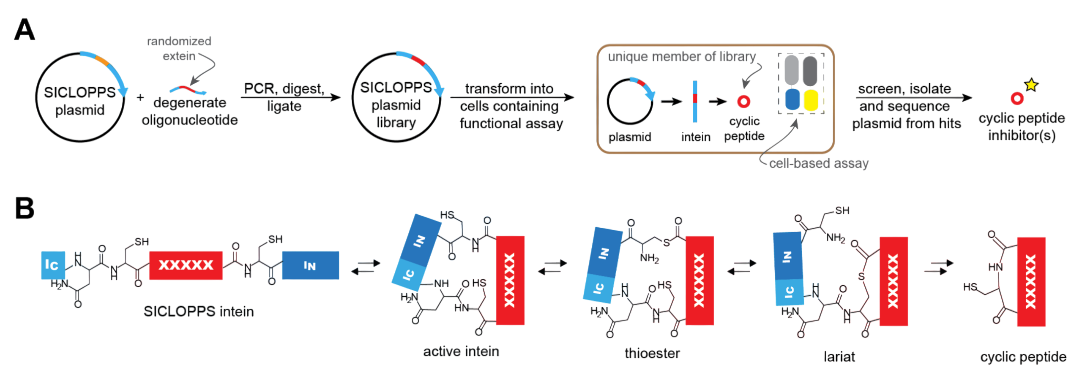
SICLOPPS (Split-Intein Circular Ligation of Peptides and Proteins) represents a fundamentally different philosophy in cyclic peptide screening. While phage, mRNA display, and DELs all screen for binding in cell-free or extracellular contexts, SICLOPPS asks a more biologically relevant question: Can your cyclic peptide function inside a living cell?
How it works
SICLOPPS exploits the biology of inteins — protein segments that can excise themselves from a larger polypeptide and simultaneously ligate the flanking sequences together (a process called protein splicing). In SICLOPPS, a "split intein" is used: the N-terminal and C-terminal halves of the intein are encoded separately, flanking a randomized peptide sequence.
Here's where the magic happens: when this construct is expressed inside a cell (typically E. coli or mammalian cells), the split intein halves recognize each other, fold together, and catalyze their own excision. In the process, they covalently join the N- and C-termini of the randomized peptide, generating a head-to-tail backbone-cyclized peptide directly in the cytoplasm.
The library of cyclic peptides is now floating around inside living cells, where they can engage intracellular protein targets, disrupt protein–protein interactions, modulate enzymatic activity, and trigger phenotypic changes. Selection is typically achieved through genetic or phenotypic readouts. For example:
- Two-hybrid systems: Peptides that disrupt a protein–protein interaction restore transcription of a reporter gene, allowing survival or fluorescence-based sorting.
- Growth selection: Peptides that inhibit an essential target prevent bacterial growth; conversely, those that rescue a toxic phenotype allow survival.
- FACS-based screening: In mammalian cells, fluorescent reporters can be used to sort cells expressing active peptides.
Because the cyclic peptides are genetically encoded, winners are identified simply by sequencing the DNA from enriched cells.
The Good
- True intracellular screening: Unlike every other platform discussed, SICLOPPS selects for peptides that are functional inside cells. This inherently filters for candidates with favorable permeability, stability, and intracellular localization.
- Physiologically relevant selection: Hits from SICLOPPS are pre-validated for cellular activity.
- Direct functional readouts: Rather than simply asking "does it bind?", SICLOPPS asks "does it do something?" — disrupting an interaction, modulating a pathway, or altering a phenotype. This is closer to the ultimate therapeutic goal.
- Genetically encoded simplicity: Library construction and hit identification rely on standard molecular biology techniques.
The Bad
- Library size constraints: SICLOPPS libraries are limited by transformation efficiency, typically ~10⁶–10⁸ members. This is respectable, but orders of magnitude smaller than mRNA display or DELs.
- Genetic code limitations: Unless combined with unnatural amino acid incorporation systems (which add significant complexity), SICLOPPS is restricted to the 20 canonical amino acids.
- Selection system dependency: SICLOPPS requires a functional cellular assay — a genetically encoded readout that links peptide activity to cell survival, reporter expression, or sortable phenotype. Not all targets are amenable to such assays, and developing robust selection schemes can be labor-intensive.
- Implementation complexity: While conceptually elegant, setting up a SICLOPPS screen requires careful design of the intein construct, optimization of expression levels, and validation of the selection pressure.
Quick comparison across the biological platforms:
- Phage Display: Viruses wear peptides like "nametags" on their surface. Selection happens outside cells. You keep the ones that stick to your target, then amplify them by infecting bacteria.
- mRNA Display: Each peptide wears its own mRNA "ID badge" physically tethered by chemical linkage. Selection happens in a test tube. Winners are identified by simply reading the badge.
- DEL: Every molecule carries a DNA barcode recipe that documents exactly how it was chemically assembled, step by step. Selection happens in vitro against purified targets. Screening is massively parallel, and decoding is done by sequencing.
- SICLOPPS: Peptides are cyclized and screened inside living cells using genetically encoded selection systems. If it works here, it's already cell-permeable and functional in a biological context.
5. Structure-Guided Design: Precision Over Proliferation
Rather than casting a wide net, structure-guided design takes a sniper's approach. Armed with high-resolution structural data of the target researchers rationally engineer peptides to fit binding pockets with atomic-level precision.
The Good
- Rational precision: Knowledge of three-dimensional target architecture enables the design of peptides with tailored affinity, specificity, and minimal off-target risk.
- Efficiency gains: Structural insights reduce the need for massive library screening, streamlining hit identification and lowering costs.
- Iterative refinement: Structural feedback loops allow continuous optimization of pharmacological properties such as affinity, selectivity and stability in a hypothesis-driven manner.
The Bad
- Data dependency: The approach hinges on availability of high-quality structural information. Poor resolution, missing loops, or dynamic regions can undermine design accuracy.
- Expertise barrier: Effective structure-guided design requires deep fluency in structural biology, computational modeling, and medicinal chemistry.
- Dynamic targets pose challenges: Proteins with high conformational flexibility, allosteric regulation, or transient binding sites may resist structure-based prediction, limiting the applicability of this strategy.
The Common Thread: Encoding, Decoding, and Chemistry
There is a shared architectural logic beneath the diversity of these platforms. Every cyclic peptide screening strategy must address three fundamental questions: How do you encode diversity? How do you decode hits? And how do you construct the peptides themselves?
Encoding: Mapping Molecules to Information
- Biological encoding (e.g., DNA in DELs, genotype–phenotype linkage in phage and mRNA display, or plasmid DNA in SICLOPPS) allows molecular identity to be read out via sequencing. This is powerful for large-scale screening but constrains chemistry to what can be synthesized or tolerated by biological systems.
- Chemical encoding (e.g., direct synthesis of cyclic peptide libraries) offers richer structural diversity, particularly when non-natural amino acids are introduced. However, tracking identity across millions of compounds requires creative tagging strategies.
Decoding: From Signal to Sequence
- DNA sequencing provides a rapid, scalable readout for biologically encoded systems. High-throughput sequencers can identify enriched binders from vast pools with minimal manual intervention.
- Mass spectrometry serves as the decoder for chemically synthesized peptides, offering precise mass determination and, with tandem MS, sequence-level resolution.
Peptide Methodologies: Building the Ring
- Enzymatic cyclization is the workhorse of biological systems. Enzymes (like inteins in SICLOPPS) catalyze backbone or side-chain linkages, often with exquisite specificity, and can incorporate post-translational modifications that enhance stability or function.
- Chemical cyclization dominates in synthetic systems. Reactions such as thiol–disulfide exchange, thioether formation via Michael addition, or amide bond formation via intramolecular coupling enable precise control over ring closure. These approaches are highly tunable, allowing incorporation of exotic chemistries unavailable to enzymes.
Chemistry Wins on Diversity, SICLOPPS Wins on Relevance
While each platform has carved out a niche in the discovery ecosystem, chemically constructed cyclic peptide libraries — particularly those leveraging DEL architectures — stand out for their unparalleled structural diversity. By liberating peptide construction from the constraints of biological machinery, these systems access chemical space that nature never explored. For researchers seeking truly novel peptide chemotypes, the chemical route remains the richest vein to mine.
However, SICLOPPS offers something no other platform can: direct selection for intracellular function. If your target lives inside cells and your therapeutic must cross membranes to reach it, SICLOPPS provides an early validation that saves countless hours of downstream optimization. It's the rare platform that asks not just "does it bind?" but "does it work where it matters?"
Acknowledgments
Thank you to Zedong Wang (wangzd@dp.tech), Dongdong Wang (wangdd@dp.tech), and Jin(Tina) Yu (yujin@dp.tech) for their valuable contributions to the content for this article series.
References
[1] Xinting Li, et al. Journal of Medicinal Chemistry. 2022, 65, 11913−11926
[2] You, S, et al. Expert Opinion on Drug Discovery. 2024, 19(8), 961–973
[3] Smith, G. P. Science, 228(4705), 1315-1317.
[4] Roberts, R. W., & Szostak, J. W. Proceedings of the National Academy of Sciences, 1997, 94(23), 12297-12302.
[5] Plais, L., & Scheuermann, J. RSC Chemical Biology, 2022, 3(1), 7-17.
[6] Moiola, M., Memeo, M. G., & Quadrelli, P. Stapled peptides—a useful improvement for peptide-based drugs. 2019, Molecules, 24(20), 3654.
[7] Tavassoli, Ali. Current Opinion in Chemical Biology 2017, 38: 30-35.

Our mission is to democratize computational drug discovery tools and empower researchers and organizations worldwide.